
Before the pathogen drifts
Most antibodies target the variable regions, because those are the largest and most visible.
Technology
How nCage builds vaccines that stay ahead of a changing pathogen: a conserved epitope, isolated from the protein around it, held on a designed scaffold and displayed on a TRAP-cage.
Watch the filmExplainer
The argument on this page, as an animated film with voice-over. Captions can be turned on for viewing without sound.
2 min 35 s
The idea
The pathogen varies. The antigen does not. That is how a synthetic antigen outruns antigenic variation.
Chapter 01 — A pathogen changes its surface
Pathogen surface proteins are under continuous selective pressure. Most of the exposed surface is antigenically variable, so antibodies elicited against one strain lose affinity for the next.
Chapter 02 — The immune system responds mainly to what changes
The response is immunodominated by the large variable surfaces. The conserved epitopes are largely ignored.
Most antibodies target the variable regions, because those are the largest and most visible.
Most of that response no longer binds. The vaccine must be reformulated, and remains one step behind the pathogen.
One antibody still fits: the one raised against the conserved region.
Chapter 03 — nCage keeps only the part that does not change
Three steps, in order. The pathogen itself is never needed.
We isolate the conserved epitope alone, defined by its three-dimensional structure rather than by the protein around it.
We then design a de novo protein scaffold: a new protein, built to hold the epitope in the conformation it adopts on the native antigen.
The epitope is grafted onto the scaffold and constrained in its native shape. The product is a synthetic antigen.
Synthetic antigen
Chapter 04 — Dozens of copies on a TRAP-cage
The synthetic antigens are then displayed on the TRAP-cage: a programmable protein nanoparticle that self-assembles from identical subunits.
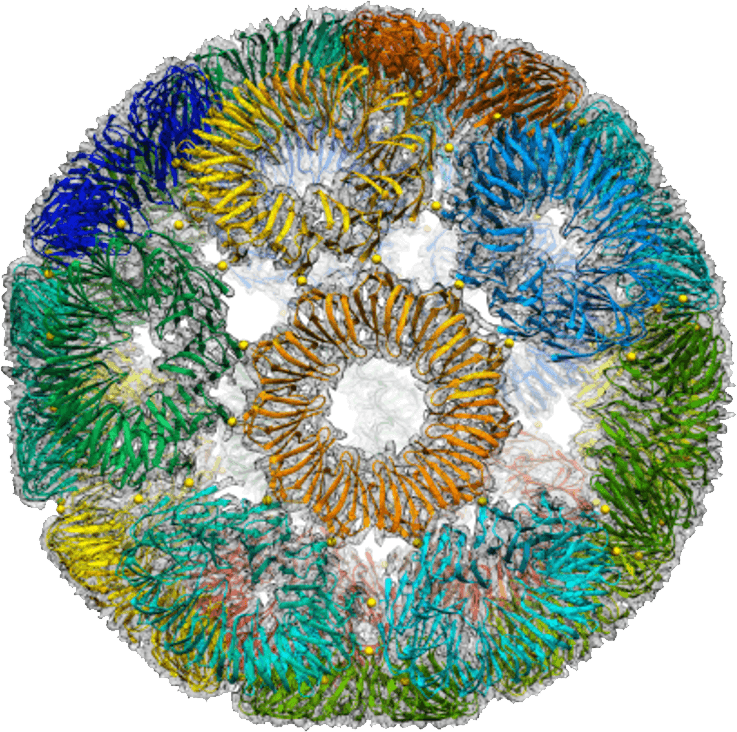
Synthetic antigens mount on the outside of the cage in a regular geometric array, at the dimensions of the virion — the pattern B cells recognize most efficiently.
The cage interior can also carry cargo: for example a conserved internal antigen, to drive a T cell response alongside the antibody response.
The result is a strong antibody response directed at the conserved epitope, and nothing else.
Chapter 05 — Antibodies that fit every variant
Because the epitope is conserved, the antibodies raised against it retain binding across circulating strains — and across variants that have not yet emerged.
10×
higher antibody titre
than the same antigen given alone, in soluble form, in preclinical models.
Strain A
Strain B
Next season
The pathogen varies. The antigen does not.
Synthetic antigens, by design
Conserved, structurally constrained targets, isolated from the pathogen and defined by their three-dimensional shape.
Epitopes held in their native conformation on designed protein scaffolds, and arrayed on the TRAP-cage at the dimensions of a virus.
nCage Therapeutics designs particles for next-generation vaccines.